![Logo 2.png]](https://support.spaceshipapp.com/hs-fs/hubfs/Logo%202.png?height=40&name=Logo%202.png)
Regulatory Background
The CPSC has long required importers of consumer products subject to a safety rule, ban, standard, or regulation to certify compliance. Previously, these certificates had to accompany the physical shipment or be available on request. The eFiling mandate aligns CPSC with other U.S. government agencies — such as the FDA, USDA, and EPA — that already require electronic data submission at entry.
The rule amends 16 C.F.R. Part 1110 and standardizes both what data must be included in certificates and how it must be submitted.
Implementation Timeline
| Milestone | Date |
|---|---|
| Final Rule approved | December 18, 2024 |
| Published in Federal Register | January 8, 2025 |
| Technical correction issued | September 24, 2025 |
| Mandatory eFiling for standard imports | July 8, 2026 |
| Mandatory eFiling for Foreign Trade Zone (FTZ) entries | January 8, 2027 |
FTZ importers receive a delayed compliance date of January 8, 2027 to allow additional time for process adaptation.
Who Is Affected
The eFiling requirement applies to:gocubic
- Importers of record (IOR): Any business importing CPSC-regulated consumer products into the U.S. for consumption, warehousing, or distribution
- Private labelers: Businesses whose brand appears on regulated products
- Cross-border eCommerce sellers: International sellers shipping direct-to-consumer into the U.S. from any country — China, UK, India, Canada, Australia, or elsewhere
- B2C shippers: There is no low-value exemption — even a $25 shipment of children's toys requires eFiling if the product is regulated
- Low-value shipment senders: Products claiming the Section 321 de minimis exemption (under $800) are explicitly not exempt from eFilingg
The CPSC FAQ explicitly states: "There is no Section 321 (also known as de minimis) shipment exemption for eFiling.
Impacted Product Categories
CPSC has identified approximately 600 HTS codes in ACE for mandatory review, selected based on historical import and risk data indicating at least half of products in each code typically require certification. Products imported under non-flagged codes may still require eFiling if they fall under a CPSC rule or standard.
Children's Products — Children's Product Certificate (CPC) Required
Children's products are defined as those primarily designed for use by children 12 years and under. CPC requires third-party lab testing by a CPSC-accredited lab.
| Subcategory | Products |
|---|---|
| Sleep & nursery furniture | Full-size cribs, non-full-size cribs, bassinets & cradles, bedside sleepers, play yards, toddler beds, crib mattresses, mattresses & mattress pads |
| Seating & carrying | High chairs, booster seats, infant bouncer seats, portable hook-on chairs, frame child carriers, soft/sling infant carriers, stationary activity centers |
| Mobility | Carriages & strollers, infant walkers, infant swings |
| Safety & sleep products | Infant bath seats, infant bath tubs, infant sleep products, infant support cushions, nursing pillows, portable bedrails, gates & enclosures, baby changing products |
| Apparel & textiles | Children's sleepwear (sizes 0–6X), children's sleepwear (sizes 7–14), wearing apparel, vinyl plastic film |
| Toys & play | Children's toys, electrically operated toys, clacker balls, dive sticks, rattles, toy/look-alike firearms, small parts |
| Furniture | Bunk beds (children's), children's folding chairs & stools, clothing storage units |
| Hazardous materials | Total lead content, lead in paints & surface coatings, phthalates, magnets, button cell or coin batteries |
| Recreation | Bicycles, bicycle helmets, all-terrain vehicles (ATVs) |
| Other | Pacifiers, hand-held infant carriers |
General Consumer Products — General Certificate of Conformity (GCC) Required
GCC covers non-children's consumer products subject to CPSC rules. General-use testing does not require a third-party lab (a "reasonable testing program" suffices).
| Subcategory | Products |
|---|---|
| Home furnishings & textiles | Carpets & rugs (large & small), mattresses & mattress sets/pads, bunk beds, clothing storage units |
| Home improvement | Drywall, cellulose insulation, architectural glazing materials, consumer patching compounds |
| Outdoor & recreation | ATVs, bicycles, bicycle helmets, walk-behind power lawn mowers, swimming pool slides (freestanding), pools & spas |
| Fire & safety | Cigarette lighters, multipurpose lighters, matchbooks, fireworks, metal-cored candlewicks, artificial emberizing materials |
| Appliances & electronics | Garage door openers, CB antennas |
| Safety devices | Adult portable bed rail, liquid nicotine packaging, portable fuel containers (flame mitigation & special packaging), refrigerator doors, refuse bins |
| Other | Wearing apparel, vinyl plastic film, magnets, button cell batteries, toy/look-alike firearms, dive sticks, lead in paints, lawn darts, special packaging |
Note: Some products appear in both lists because they are regulated regardless of whether they are children's or general-use products (e.g., magnets, button cell batteries, carpets & rugs).compliancegate
Products NOT Required to eFile
eFiling is generally not required for:
- Raw materials or component parts (only finished consumer products are regulated)
- Products not subject to any CPSC rule, ban, standard, or regulation
- Adult wearing apparel qualifying under specific flammability exemptions
- Gifted products shipped between two private individuals (non-commercial)
- Domestic manufacturers (for now — similar requirements may follow in future regulatory phases)
B2C and Direct-to-Consumer Shipping: Full Impact
This is one of the most operationally significant aspects of the mandate for logistics businesses:
The Seven Required Data Elements
Regardless of filing method, the following seven data elements must be provided for each regulated product per shipment:
- Product Identifier — One of: GTIN, SKU, UPC, Model Number, Serial Number, Registered Number, or Alternate ID
- Cited Safety Rule — The specific CPSC regulation(s) to which the product is certified (e.g., 16 CFR Part 1250)
- Date of Manufacture — Manufacture/production/assembly date of the finished product
- Place of Manufacture — Name, full address, and contact information of the manufacturing party
- Date of Most Recent Compliance Testing — Date of the most recent product compliance test
- Testing Laboratory Contact Information — Name, full address, and contact information of the testing lab
- Records Keeper Contact Information — Name, full address, and contact information of the party maintaining test result records
Two Filing Methods
Importers may choose one of two methods to transmit data through ACE:foley+1
Method 1: Full PGA Message Set
Submit all seven data elements with each customs entry via a CPSC Participating Government Agency (PGA) message set in ACE.
- Best for: Importers with a small number of regulated products, infrequent shipments, or highly variable product mixes
- Drawback: Data must be re-entered for every individual shipment, making it more time-intensive at scalefoley
Method 2: Reference PGA Message Set (Recommended for Repeat Shippers)
Pre-register product certificate data in CPSC's secure Product Registry (a separate CPSC repository from ACE). At time of entry, only three identifiers are transmitted in ACE:
- Product ID
- Certifier ID
- Version ID
- Best for: Importers repeatedly shipping the same SKUs — data is entered once, then referenced indefinitely
- Advantage: Reduces invoice data burden, speeds clearance, and lowers risk of data entry errors
- Note: Data in the Product Registry must be updated whenever product information changes (e.g., new manufacturing batch)
Submitting CPSC CoC via Spaceship Pro
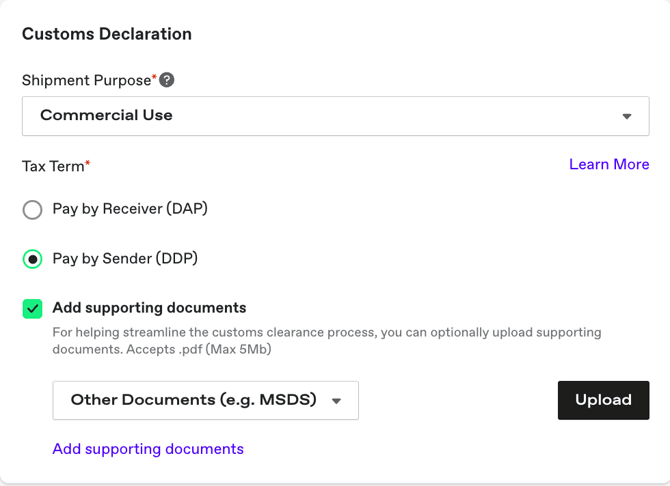
Spaceship Pro's Customs Declaration section includes an "Add Supporting Documents" feature that allows customers to upload a PDF (max 5MB) alongside their shipment.
How to Upload a Supporting Document on Spaceship Pro
- Go to Customs Declaration when creating or editing a shipment
- Check "Add supporting documents"
- Select "Other Documents (e.g. MSDS)" from the dropdown
- Click Upload and attach the CoC PDF (max 5MB, PDF format only)
Shipment Review Statuses in ACE
When a shipment is flagged or selected for CPSC review, CBP's 1USG Messaging Program communicates the status to importers:
| Status | Meaning |
|---|---|
| Under Review | Shipment may move to importer's premises but cannot enter commerce until CPSC completes review |
| Hold Intact | Shipment is held for examination and cannot move until released by CPSC |
| May Proceed | Shipment cleared CPSC review (may still require other agency clearance) |
| 1USG Clearance | CBP-issued confirmation that all relevant agencies have cleared the shipment |
Consequences of Non-Compliance
Failure to properly eFile can result in:
- Shipment holds or delays — CBP places the shipment under review until certificate data is submitted
- Physical examination — Products without proper eFiling face higher inspection rates
- Accumulating storage fees — Cargo held at ports incurs demurrage and warehouse costs
- Additional information requests — CPSC may require documentation before release
- Refusal of entry — The shipment may be denied release entirely
- Customs broker liability — Brokers filing entries without required CPSC data may be held personally liable by the CPSC
- Applicable PGA submission fees
Importers must also maintain compliance certificates and supporting test or certification records for at least five years from the certificate creation date.
Step-by-Step Compliance Checklist
- Step 1: Review your product catalog against the CPSC's ~600 flagged HTS codes (available at cpsc.gov/eFiling)
- Step 2: Determine certificate type — GCC (general consumer product) or CPC (children's product requiring third-party testing)
- Step 3: Choose a filing method — Full PGA Message Set or Reference PGA Message Set
- Step 4: If using Reference method, register on CPSC Product Registry at cpsc.gov/eFiling-CPSC-Product-Registry
- Step 5: Update commercial invoice templates to include a Remarks field or addendum for CPSC data
- Step 6: Brief manufacturers and suppliers — manufacturing date, location, and lab details must come from them
- Step 7: Confirm Power of Attorney status with customs broker (required for shipments over $5,000 USD)
- Step 8: Designate a central point of contact for eFiling coordination across supply chain partners
- Step 9: Update internal compliance programs and train relevant staff
- Step 10: Monitor CPSC for updates to flagged HTS codes and regulatory changes
CPSC Official Resources
| Resource | Purpose | Link |
|---|---|---|
| CPSC eFiling Hub | Central documentation and updates | cpsc.gov/eFiling |
| Product Registry | Register products and store certificate data | cpsc.gov/eFiling-CPSC-Product-Registry |
| eFiling Quick Start Guide | Step-by-step instructions for getting started | Available at cpsc.gov/eFiling |
| Regulatory Robot | Determine which CPSC standards apply to specific products | cpsc.gov (search "Regulatory Robot") |
| eFiling Document Library | Flagged HTS code list and reference materials | cpsc.gov/eFiling |
| eFiling FAQ | Official answers to common questions | cpsc.gov/FAQ/eFiling-Frequently-Asked-Questions-FAQ |
| Email Support | Technical assistance | eFilingSupport@cpsc.gov |
Frequently Asked Questions (FAQ)
Q: Does eFiling apply to all US-bound shipments?
A: It applies to any shipment of finished consumer products that fall under an CPSC rule, ban, or standard — regardless of origin country, shipment size, or value.
Q: Is there a de minimis exemption for low-value packages?
A: No. The CPSC FAQ explicitly confirms there is no Section 321 (de minimis) exemption. Even products under $800 in value must comply if they are CPSC-regulated.
Q: Can my freight forwarder or customs broker file on my behalf?
A: Yes, your customs broker or courier handles transmission to CBP — but they can only transmit data you supply. They cannot generate or certify compliance. The Importer of Record remains legally responsible for accuracy.
Q: What if my product's HTS code is not on the flagged list?
A: eFiling is not required for that specific entry, but your product may still fall under CPSC regulations. Keep valid GCC/CPC documentation on file in case of a request. Use the CPSC Regulatory Robot to confirm.
Q: Do I need to re-file if manufacturing details change between batches?
A: Yes. Certificate data must be accurate and current. If using the Product Registry, update registered product data whenever manufacturing information changes.
Q: What about shipments into Foreign Trade Zones?
A: FTZ-imported goods have a delayed compliance date of January 8, 2027.
Q: Is eFiling required for electronics?
A: Not automatically for all electronics. However, electronic toys or electronics containing button cell batteries or magnets are likely covered due to those specific component rules.
Q: What if I ship on DDP terms?
A: Under DDP, the seller handles customs clearance on the buyer's behalf and assumes Importer of Record responsibility. Full eFiling compliance is the seller's obligation
Last Updated On 7 Jul 2026